


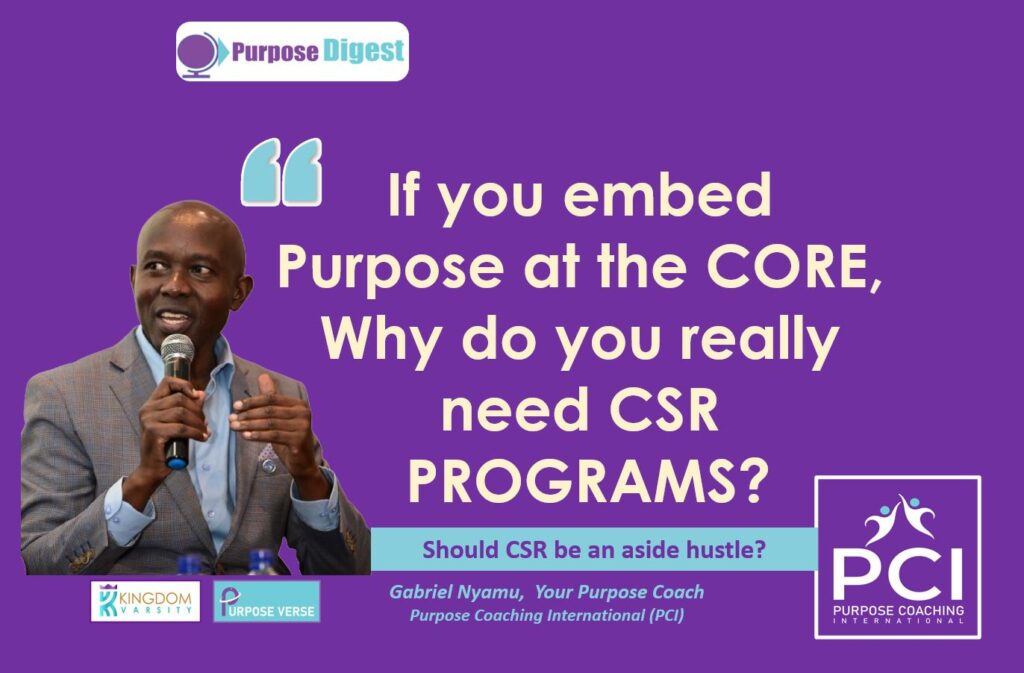
Many organizations today treat Corporate Social Responsibility as a side hustle program – a feel-good add-on designed to signal impact or goodness while the core business model remains detached from societal transformation.
CSR becomes:
But here’s the truth most people don’t want to say out loud:
Many times, CSR often exists because the core business has failed to carry redemptive value in the first place.And when this happens, CSR stops being noble – it sometimes becomes diversionary.
In Purpose-Led strategy circles, I always bring leaders to these two distinctions:
This is the higher call. Your business model itself is the ministry, the mission, the impact pathway. Your offerings are not mere products but are rather redemptive solutions and are transformational. The core business itself is the social good.
Examples:
Here, CSR is redundant because the purpose is already embedded within the core business. Participation in other social impact ventures becomes collaborative compliments and not the core.
This is still noble but must be handled with some piece of caution. It means the business generates resources to fund societal impact. But – and this is the tension — the business itself does not inherently produce transformation. Impact becomes an external arm, not an internal engine.
This is where many CSR programs sit.
So… Are CSR Programs Wrong?Not at all.
But they become problematic when leaders:
CSR should never be:
CSR for mission (#2 type) should be:
Purpose-First ventures start with this conviction:
Your greatest redemptive impact must come from your core mandate, not from a separate CSR program.Redemptive Impact must be:
CSR then becomes a bonus – not a short term bandage to nurse market hurts.
Try asking this in your next leadership meeting:
“If we canceled every CSR project today, would the world still be better because our business exists?”
If the answer is no, then CSR is not the issue. Business model redesign is.
A purpose-integrated business does not need to add impact – it is impact.
This is where the world is going:
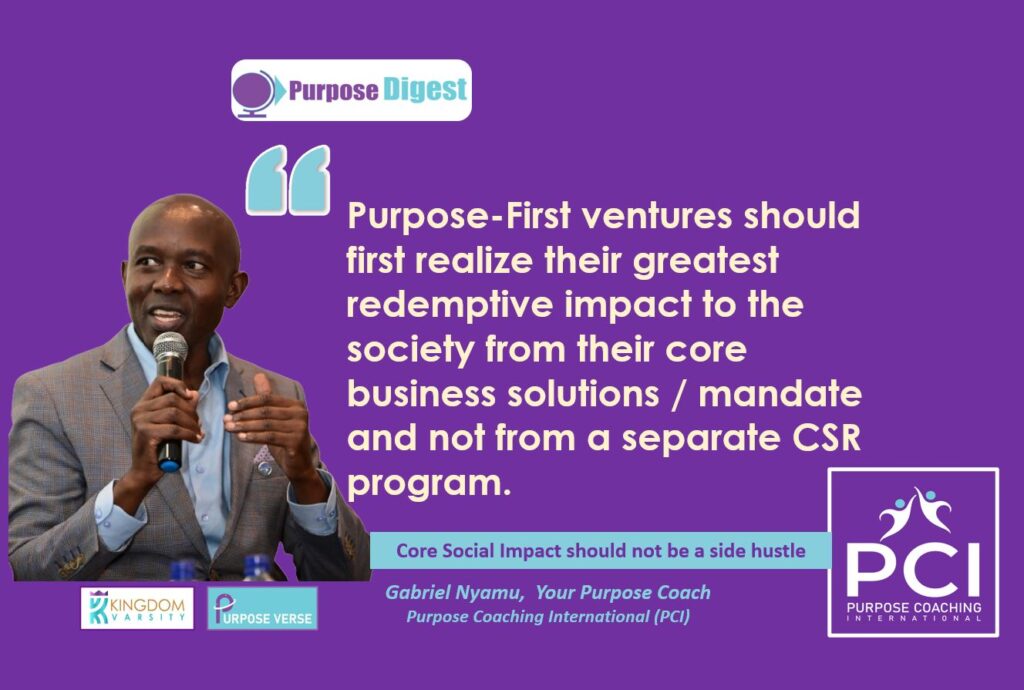
And Boards that fail to shift… will miss the next decade of competitive advantage.
What’s Your Take?
I know this topic stirs emotions because executives genuinely care – but the models we inherited were not built with purpose at the core.
So I’m genuinely curious:
Do you believe CSR programs are diversionary, or do they still carry strategic value? How should organizations balance Business-as-Mission vs Business-for-Mission?
Drop your thoughts – I’d love to hear diverse perspectives from leaders across sectors.
Remember to also join my Global Purpose Led Community ready to move from misaligned achiever to redemptive builder.
Gabriel Nyamu, Purpose Coach | Founder, Purpose Coaching International |
W/UP: +254 780 676703 E: impact@purposeverse.co.ke
#PurposeLed #MeaningfulWork #RedemptiveOrganizations #PurposeCoaching #FITLiving

Gabriel Nyamu says:
What is your perspective?